A boom lift-type aerial work platform is a unique piece of machinery. This is what makes it so useful but can also present a challenge to those tasked with learning how to operate a boom lift. If your company has signed you up for a course and you find yourself wondering what you’re in for, this article is for you.
If you are a contractor who is considering incorporating a boom lift into your arsenal and would like to know more about this machine, you may also find this to be handy. So, without further ado, let's get in and go - which is precisely what you should not do with one of these machines:
1. Be Trained and Certified
Do not consider this article to be sufficient knowledge for operating a highly specialized piece of machinery like a boom lift - that would be incredibly dangerous. In most, if not all jurisdictions, it is illegal to operate a boom lift without valid certification which involves hands-on training.
This also involves the right personal protective equipment. Usually, this means a fall restraint 5-point harness and a hardhat, steel-toes, and vis-vest. Also, safety glasses for performing inspection of the machine - one the most critical components of operating.
Most companies pay for their workers to be certified and trained and are obligated to ensure competency in the field. With the obvious disclaimer out of the way we still aren’t ready to get in and drive. Let’s take a look at our machine.
2. Vehicle Inspection
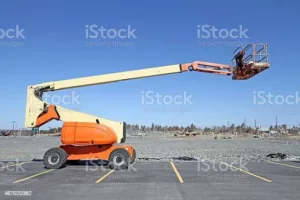
In the photo above we have an articulating-arm version of a boom lift. This just means it has an elbow - the smaller arm attaching to the boom lift. At the right end you have a man basket and to the left is the chassis and base. We begin inspection at the tires and work our way around. We are looking for several things in particular. Damage to the tires - they may be foam-filled which can take significantly more damage than pneumatic (air-filled) tires.
We also pay a close eye to any metal damage. Scratches are typical and nothing to worry about, but any deformation in the steel that makes up the boom and chassis must be noted and inspected further by a mechanic or engineer. We also look for issues with the hydraulic lines and piston.
Wear your P.P.E. and use a piece of cardboard to check for leaks, especially around the fittings. If hydraulic fluid sprays and breaks your skin, you must go to the hospital immediately as your
life is in peril. This is another reason we make sure we are trained with hands-on experience and instruction.
The next step will be to test the auxiliary controls, located on the side of the machine. You can operate these machines from the ground for several reasons including storage and rescue and should be tested before going in the air. We’re not quite ready to hop in and drive yet, but we are getting close.
3. Environment Assessment
You need to know what is under you, around you, and above you. Is the ground firm enough or flat enough? These machines can operate on a small level of grade, but the flatter the better - for reasons that are hopefully obvious (stability). If you are on a concrete surface, don’t assume that it can hold the weight of these vehicles which weigh literal tons. Around you - buildings, lamp standards, and traffic are common things to look for, and above you - power lines and ceilings are the main concerns. Ok, so how do we actually drive this darn thing?
4. Operating the Boom Lift
We aren’t going to dwell too much on controls because different makes and models have different configurations. Generally, you will have 2-speed controls denoted by a rabbit and a turtle - start with the turtle. There will also be boom controls - up, down, swing left and right, and a telescoping control. These will vary depending on the machine, and configuration of the boom. All machines will have drive controls as well, which again vary by make and model.
Keep in mind that the controls become reversed when you swing the boom around 180 degrees. It takes practice training and consideration to operate safely. When driving forward the boom will follow the chassis and you should be elevated enough to see over in front of where you are going. Most boom lifts are front-wheel steering.
The main thing to think about with operating the lift is your positioning. Beginners have a habit of getting far too close to the work and then they are unable to swing in. This is known as being ‘boom-bound’. To avoid this, you should keep the base of the machine further away from the work than your boom is long (scoped in).
Next, swing your boom and point it at the work - you may not be able to reach it yet, but that is good. You want to use the telescope function last as it is the slowest - which is important.
When you boom up or down or swing the base, it is a big motion. There is some rocking involved and it takes getting used to. The scoping function is much slower and more controlled. As you get closer to what you are working on, you should avoid swinging, raising, or lowering the boom.
Use the scope to get in close, like a pro.
5. Ensure Success from the Start
A machine that is well maintained and looked after is what makes it reliable, useful, and safe. MAK Industries is a locally operated company with a sound reputation for quality equipment. If you're looking to add a boom lift or any other related machinery to your site, we highly recommend calling their sales team for any rental or purchase inquiries. At the end of the day, a good machine makes the difference. MAK makes that happen.