
a.btn.btn-primary.btn-block {
background: rgb(236, 29, 37);
color: white;
border-radius: 0px;
border: none;
padding: 8px 18px;
font-size: 16px;
font-weight: 200;
width: 90%;
margin: 5px;
text-align: center !important;
}
a.btn.btn-primary.btn-block:hover {
background: rgb(236, 29, 37) !important;
}
h1, h2, h3, h4, h5 {
font-style: italic;
font-weight: bold;
}
Telehandler History: What Do You Need To Know?
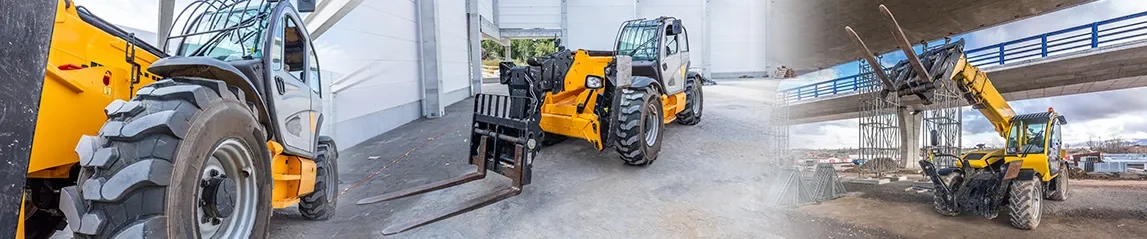
Before we review telehandler history, let’s first define what a telehandler is. The term “telehandler” is short for “telescopic handler” because it is a machine primarily used in construction, industry, and agriculture to move and place materials. This multipurpose machine accepts various types of attachments to lift and relocate most things you’ll find around a job site, ranging from lumber to bricks to gravel.
Telehandler Purposes
When beginning a construction job, telehandlers are typically first on the scene to assist with setup. Telehandlers are also some of the last machines to leave because of their usefulness when taking down a job site. Telehandlers are highly versatile, cost-effective solutions for staging and lifting an array of materials, pallets, and suspended loads.
Other Names for Telehandlers
Today, telehandlers use a variety of attachments to “pick and carry” loads, work around obstacles, and operate in rough-terrain conditions. These are such useful tools that several nicknames for them have evolved throughout the history of telehandlers. Other common names for them are:
- Lull
- Teleporter
- Reach Forklift
- Zoom Boom
Popular Telehandler Manufacturers & Brands
If you have a job on the books that requires a versatile piece of aerial equipment to help you carry heavy loads and reach over obstacles, then you’ll find what you need in our telehandler for sale inventory. We have a wide selection of new models that provide a range of load, reach, and weight capabilities. We typically carry new telehandlers from the most popular brands, including:
- Genie
- JLG
- JCB
- Sky Trak
- Caterpillar
- Lull
- Manitou
- Gehl
- Terex
- Skyjack
Who Invented the Telehandler?
The history of the telehandler starts with who invented it. Credit for the invention goes to Joseph Cyril Bamford. Now, if those initials seem familiar, it’s because Mr. Bamford established JCB in 1945 and invented the telehandler in 1977. Ever since, JCB has been one of the top manufacturers of these products and heavy-duty construction equipment.
We are proud to stock a wide selection of JCB telehandlers in our sales inventory, as well as telehandler rental options. We also rent other heavy-duty machinery. Look at our forklift rentals if you need a forklift for a weekend job. You’ll find a selection of Genie and JCB forklifts for rent, among other popular brands.
The Lull telehandler history started circa 1959, around the time a man named Legrand Lull formed Lull Engineering. Today, Lull telehandlers are made by JLG. The Lull forklift history shares a similar story and timeline.
Choosing a Telehandler
One of the most common questions we receive at our heavy-duty equipment retailer is, “Do I need a telehandler or a forklift?” This is because telehandlers and forklifts share many common traits and capabilities. Telehandlers are typically chosen over forklifts because of their different attachments and are better suited to loading hoppers and high-sided trucks.
One of the most important factors in choosing the right telehandler is where you plan to use it. Will you be indoors or outdoors? Will you be on a flat, paved surface or a slippery, uneven surface? Will you be working in high wind? Will you be in high wind on loose, unstable soil or gravel? Considering the conditions of your workspace is a crucial step in choosing the best telehandler.
If this feels overwhelming, don’t worry — that’s where our heavy equipment supply business comes in. Our team of experts is here to help you choose the right tool for the job.
Telehandler Sizes and Load Capabilities
When it comes to choosing the best telehandler for your application, you’ll find a wide selection of sizes and attachments available. We can filter your search by the following categories:
- Lift Capacity
- Drive
- Horsepower
- Hours
- Maximum Lift Height
- Operating Weight
- Transmission Type
- Wheelbase
So, how much do you need to lift, and how high do you need to lift it? Telehandler weight capacities typically range from 4,000 to 14,000 pounds with a maximum lift height of 19-56 feet.
Popular Telehandler Attachments
Several telehandler attachments have been invented and refined throughout telehandler history. When it comes to telehandlers vs. forklifts, people typically choose telehandlers because of the various available attachments.
One of most the common telehandler attachments for sale are buckets. We carry a large selection of telehandler buckets for sale and rent, including:
- Grapple Buckets
- Material Buckets
- Fork-Mounted Buckets
After buckets, carriages are the most popular telehandler attachments. We carry:
- Dual Fork Positioning Carriages
- Side-Shift Carriages
- Side-Tilt Carriages
- Standard Carriages
- Swing Carriages
When you need a telehandler to lift pallets onto high shelves or move lumber, you need a telehandler fork attachment, such as:
- Cubing Forks
- Fork Extensions
- Lumber Forks
- Pallet Forks
Frequently Asked Questions
What was the first telehandler?
The first telehandler was invented in 1977 and was known as a telescopic forklift. The JCB 520 Loadall Telehandler combined the forklift, backhoe, and crane into one do-it-all machine. This two-wheel-drive machine revolutionized the industry and is still one of the most commonly used pieces of heavy-duty equipment today.
Who invented the telehandler?
Joseph Cyril Bamford founded JCB in 1945. He would forever change forklift history by creating the telehandler in 1977. Since its invention, JCB has been one of the top manufacturers of telehandlers and other heavy-duty construction machinery globally. We proudly carry JCB telehandlers for sale at our construction equipment supply company.
What are telehandlers used for?
Telehandlers carry cumbersome loads around a job site and lift heavy loads to hard-to-reach places. Telehandlers share many characteristics with forklifts but are different from forklifts because telehandlers allow for various task-specific attachments to be installed to allow for a wide variety of applications. Common attachments include a pipe grapple, sheet material handler, and sweeper.
{
“@context”: “https://schema.org”,
“@type”: “FAQPage”,
“mainEntity”: [
{
“@type”: “Question”,
“name”: “What was the first telehandler?”,
“acceptedAnswer”: {
“@type”: “Answer”,
“text”: “
The first telehandler was invented in 1977 and was known as a telescopic forklift. The JCB 520 Loadall Telehandler combined the forklift, backhoe, and crane into one do-it-all machine. This two-wheel-drive machine revolutionized the industry and is still one of the most commonly used pieces of heavy-duty equipment today.
”
}
},
{
“@type”: “Question”,
“name”: “Who invented the telehandler?”,
“acceptedAnswer”: {
“@type”: “Answer”,
“text”: “
Joseph Cyril Bamford founded JCB in 1945. He would forever change forklift history by creating the telehandler in 1977. Since its invention, JCB has been one of the top manufacturers of telehandlers and other heavy-duty construction machinery globally. We proudly carry JCB telehandlers for sale at our construction equipment supply company.
”
}
},
{
“@type”: “Question”,
“name”: “What are telehandlers used for?”,
“acceptedAnswer”: {
“@type”: “Answer”,
“text”: “
Telehandlers carry cumbersome loads around a job site and lift heavy loads to hard-to-reach places. Telehandlers share many characteristics with forklifts but are different from forklifts because telehandlers allow for various task-specific attachments to be installed to allow for a wide variety of applications. Common attachments include a pipe grapple, sheet material handler, and sweeper.
”
}
}
]
}